Two hours, ten stops, zero stress. Copenhagen’s most recognizable landmarks come with human-scale storytelling on a max 12-person walk, and I like how the local host keeps the English easy to follow. One thing to plan for: most stops are quick outside-and-photos moments, so if you want lots of museum time, you’ll need to add it yourself.
You start at Marmorkirken (the Marble Church) near public transit, then drift through royal squares, a former naval neighborhood, and classic Old Town streets before ending in Nyhavn for a coffee or pastry. The result is a smart way to get your bearings fast—without feeling like you’re sprinting between postcard backdrops.
Weather can be a factor in Copenhagen. Even on a wet and windy day, the best version of this tour adapts with a warm break while the guide keeps the history rolling, so you don’t lose the whole experience to the sky.
In This Review
- Key things to love about this Copenhagen walk
- Finding the group at Marmorkirken (and why the start matters)
- Frederiks Kirke (Marmorkirken): the Marble Church dome and the 150-year build
- Nyboder’s naval neighborhood: Memorial Rooms and Krusemyntegade’s row houses
- Rosenborg Castle at the heart of Kongens Have (King’s Garden)
- The Round Tower (Rundetårn): spiral design and why it matters
- Gråbrødretorv and Amagertorv: shaded squares between major icons
- Christiansborg Palace: where royal roots meet modern government
- Nikolaj Church area and Kongens Nytorv: Old Town skyline variety
- Nyhavn finish: colorful canal houses, ships, and the best kind of leftover time
- Price and value: is $28.43 for 2 hours a fair deal?
- Who this tour suits best (and who should pick something else)
- Should you book this Copenhagen Highlights & Landmarks walk?
- FAQ
- How long is the Copenhagen walking tour?
- Is the tour offered in English?
- What is the group size?
- Where do I meet, and where does the tour end?
- Is admission included for the stops?
- Will I be walking a lot?
- Is there a mobile ticket?
- What’s the final area like after the tour?
Key things to love about this Copenhagen walk
- Small-group pace (12 max): more questions, less “stand here and hope” energy
- Icon-to-icon routing: Marble Church, Rosenborg, Round Tower, Christiansborg, and Nyhavn in about 2 hours
- Nyboder’s naval stories: you’ll get context for houses and street patterns that otherwise look random
- Short photo stops, not long detours: you see a lot, then move on before crowds build
- English-led with clear explanations: the tour is built for understanding, not just following along
- Nyhavn as the finish line: you end where you’ll actually want to slow down
Finding the group at Marmorkirken (and why the start matters)
The meeting spot is right by the stairs leading down to the Marble Church Metro Station, next to a 7-Eleven. That detail is more useful than it sounds—when you’re trying to start on time, having a big, obvious landmark reduces stress.
This matters because the tour is only about 2 hours, so you’ll feel the efficiency. Once everyone’s together, you’ll move through several neighborhoods with enough rhythm to stay comfortable, but not enough time to wander off on your own.
If you like tours that help you walk with confidence, this one is built for that. You get a guided line through the city center, plus explanations that make the streets feel less like a maze.
You can also read our reviews of more tours and experiences in Copenhagen.



Frederiks Kirke (Marmorkirken): the Marble Church dome and the 150-year build
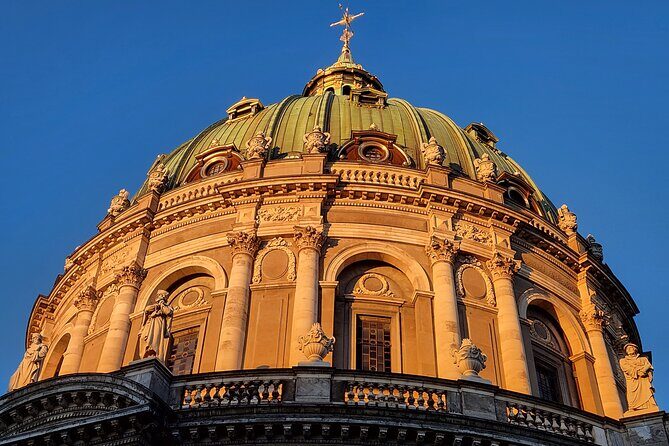
Your first stop is Frederiks Kirke, also called Marmorkirken or the Marble Church. It’s famous for its huge dome—described as the largest in Scandinavia—and the story behind it is part engineering, part ambition, and part devotion.
The church was inspired by St. Peter’s Basilica in Rome, and the marble work took more than 150 years to complete. If you’re the type who notices details (and even if you’re not), this is a great spot to look upward and see why Copenhagen loves architecture that signals power and patience.
You’re also in Frederiksstaden, the royal district around the church. Even if you don’t go inside, this stop helps you read the city: you’ll understand why the neighborhood feels formal compared to the busier shopping streets later.
Nyboder’s naval neighborhood: Memorial Rooms and Krusemyntegade’s row houses
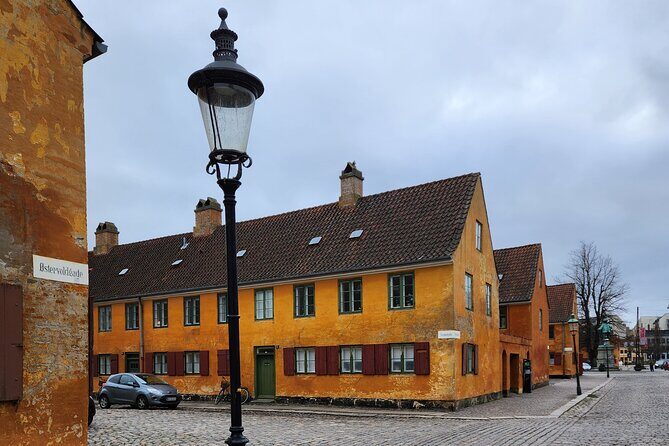
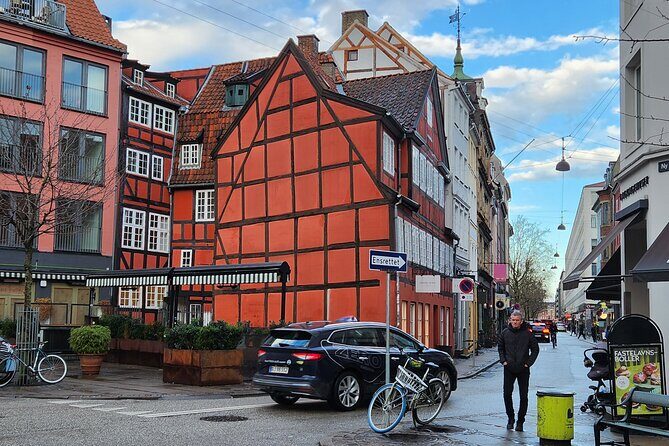
Next you head into Nyboder, Copenhagen’s old naval quarter. The neighborhood was founded in 1631 by King Christian IV to house Denmark’s sailors and their families. That one fact changes how you look at the street layout and the repeating architecture.
The tour includes a stop at the Nyboder Memorial Rooms. The important practical note here: the ticket is not included, so it’s more like a short, exterior/peek-and-learn moment unless you choose to pay for entry. If you want the scenes preserved behind windows to make sense, this is the portion where the guide’s explanation really pays off.
After that, you’ll wander through Krusemyntegade, a peaceful street lined with colorful, historic houses in the same Nyboder area. This is a slower-feeling interlude. You get a chance to look at the neighborhood as more than a museum stop—think of it as a living reminder of how sailors lived when “the sea” was a daily reality.
Why this works: it’s not just pretty buildings. You learn the logic behind them—who they were for and why they were built the way they were.
Rosenborg Castle at the heart of Kongens Have (King’s Garden)
Then you arrive at Rosenborg Castle, a Renaissance-style royal landmark built in the early 1600s by King Christian IV. The castle gets described as fairytale-like, but what I like is that it sits inside a calm setting—Kongens Have (King’s Garden)—so the contrast with the city outside feels immediate.
Even if you don’t go in, this stop is strong for two reasons. First, you get iconic exterior photo angles. Second, the garden setting helps you understand why monarchs and power centers in Copenhagen weren’t always about noise and crowding.
The practical catch: admission is not included for this stop. So treat it as a guided look and a photo moment unless you plan to add a castle visit on your own schedule.
The Round Tower (Rundetårn): spiral design and why it matters
Copenhagen’s Round Tower (Rundetårn) is one of those landmarks you recognize even when you’re not sure how. It was built in 1642 under King Christian IV, and it was designed as Europe’s oldest functioning observatory.
The exterior is the star: the spiral form and the copper-clad roof rising over the old town skyline. It’s also a great “pause and look” stop, because it gives your eyes something to latch onto while the guide ties the site to royal curiosity and scientific life.
Admission here is listed as not included, so expect this to be an outside viewpoint. For many visitors, that’s enough. The point of this walk is to give you a big-city overview without getting stuck in one place too long.




Gråbrødretorv and Amagertorv: shaded squares between major icons
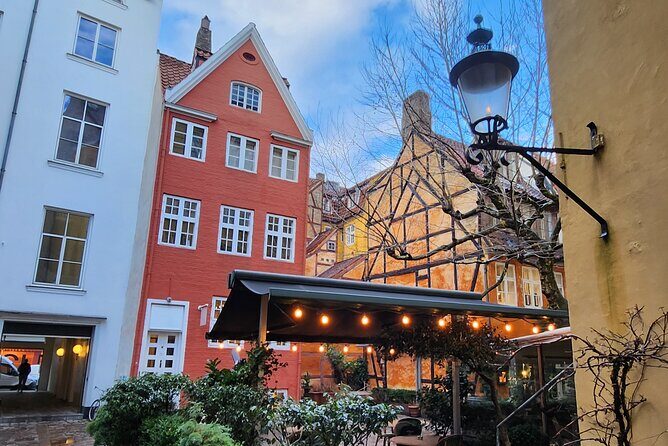
Not every stop is a palace or church. This tour also slows down for squares.
First comes Gråbrødretorv, described as one of Copenhagen’s picturesque squares, shaded by large trees and bordered by historic townhouses. The practical value: you get a breather before the tour presses back into the city-center rhythm. If you’re tired from walking, this kind of pause keeps you from feeling like the last hour is punishment.
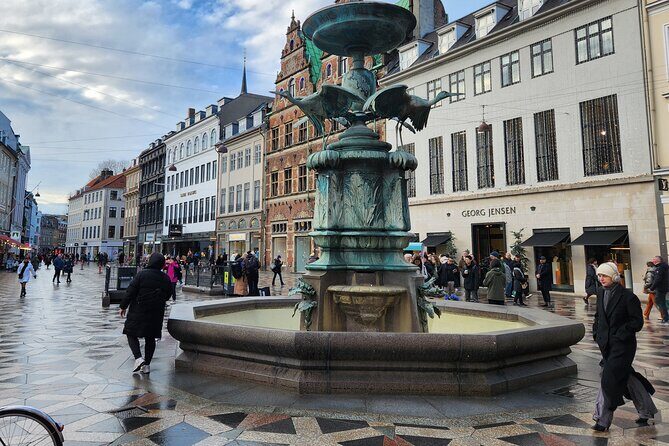
Then you reach Amagertorv and the Stork Fountain area, in the heart of Strøget (Copenhagen’s shopping district). This part is about energy and street life: the mosaic pavement, the fountain, and the grand surrounding architecture.
A good way to use this moment: step slightly back from the fountain so you can take in the buildings around it, not just the landmark itself. It helps you “read” the city scale as you move toward the next royal site.
Christiansborg Palace: where royal roots meet modern government
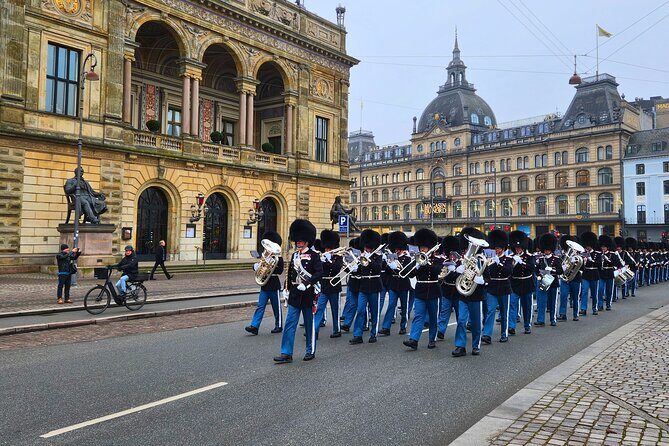
At Christiansborg Slot, you’re in the middle of Copenhagen’s civic and royal storyline. The palace sits on Slotsholmen Island and today houses Denmark’s Parliament, Supreme Court, and the Royal Reception Rooms.
It’s described as the only building in the world uniting those branches of government under one roof. That’s a big claim, but even without the superlatives, it’s easy to see why this stop is memorable: the building is both grand and current.
From the outside, you’ll notice the façade and ornate copper spire. The guide’s storytelling here is the glue—connecting “kings and queens” with the fact that government functions in this same space.
Admission isn’t listed as included, so again, plan on an outside viewpoint plus explanation rather than a deep interior visit.
Nikolaj Church area and Kongens Nytorv: Old Town skyline variety
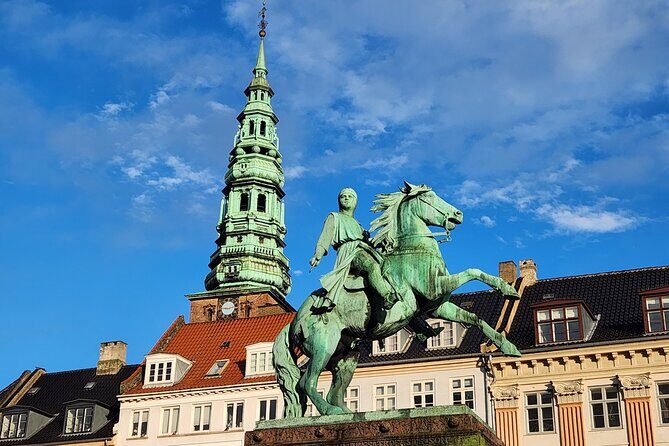
After Christiansborg, the tour moves you toward Nikolaj Kunsthal, which is tied to Nikolaj Church—a historic church building first referenced as far back as the 1200s. You’ll mostly be seeing it from the outside, with an emphasis on the iconic spire and the way it punctuates Copenhagen’s skyline.
Then you reach Kongens Nytorv (King’s New Square), one of the city’s grand central squares. It sits near major landmarks like the Royal Danish Theatre and Hotel d’Angleterre, plus it’s connected to the Nyhavn area you’ll reach later.
This stop works as a bridge. You’re moving from royal-government sites into the old waterfront story, and the square gives you a central reference point—useful for navigation after the tour ends.
Nyhavn finish: colorful canal houses, ships, and the best kind of leftover time
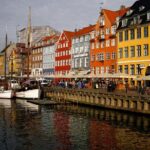
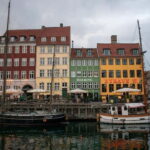
The last stop is Nyhavn, Copenhagen’s most iconic waterfront strip. The canal is known for colorful 17th-century townhouses, historic wooden ships, and the café culture that makes it feel like a meeting place rather than just a photo corridor.
Nyhavn’s past was practical: it was once a trading harbor with sailors and storytellers. The guide ties in Hans Christian Andersen, who once lived here, which is a nice way to connect literature to the physical streets around you.
The best part for your planning: the tour ends with you right where you’ll want to linger. You can grab a coffee or pastry at a local café without the scramble of figuring out how to get there.
If your walking plan is tight, use Nyhavn as your reward. It’s also a smart choice for solo travelers who want a safe place to pause and recharge.
Price and value: is $28.43 for 2 hours a fair deal?
At about $28.43 per person for roughly 2 hours, this feels like a practical value proposition—especially because it’s a live local guide and limited to 12 travelers. You’re not just collecting stamps from a checklist. You’re getting explanations that connect the buildings to the people and periods that shaped them.
The route also packs in a lot of recognizable stops without asking you to commit a whole day. That matters if you’re visiting Copenhagen for a short stay or if you want a first-day orientation walk before doing more independent exploring.
What you should factor in: several stops list admission not included. If you want to go inside (for example, the Nyboder Memorial Rooms ticket is not included, and other sites are also noted as not including admission), the tour price is still fair, but your total cost can go up depending on what you choose to enter.
Still, even with that in mind, you’re paying for context and efficient routing. That’s the real value here.
Who this tour suits best (and who should pick something else)
This walk is ideal if you want a fast, guided introduction to central Copenhagen. It’s especially good for first-timers who feel overwhelmed by how much there is to see and want a clean path between major landmarks.
It also fits well if you like architecture and city stories. The Marble Church, Rosenborg area, Round Tower, and Christiansborg all cover different sides of Copenhagen—religion, monarchy, science, and civic life—without turning into a lecture.
You might choose another option if you’re hoping for long museum time at multiple indoor sites. The overall pattern here is short stops, outside views, and guided context, with admission becoming an add-on where tickets aren’t included.
And because the tour notes moderate physical fitness, it’s best for people who can handle steady walking for about two hours without needing frequent breaks.
Should you book this Copenhagen Highlights & Landmarks walk?
I’d book it if you want a first-time orientation that hits the famous places while also slowing down enough to understand what you’re looking at. The small-group size, clear English, and the smart ending in Nyhavn make it easy to turn the tour into an actual plan for the rest of your day.
Skip it or add another tour if your top priority is paid museum entry at multiple stops. This is a “see and understand” route, not an all-access ticket marathon.
If you like practical city walking with a local guide, this is a strong way to get comfortable in Copenhagen—fast.
FAQ
How long is the Copenhagen walking tour?
It’s about 2 hours (approx.).
Is the tour offered in English?
Yes. The tour is offered in English.
What is the group size?
The experience has a maximum of 12 travelers.
Where do I meet, and where does the tour end?
You meet at Marmorkirken (address listed as Marmorkirken 1264 Copenhagen) and the tour ends at Nyhavn 28, 1051 Indre By, Denmark.
Is admission included for the stops?
Not always. Frederiks Kirke (Marmorkirken) is noted as Free. For other stops like Nyboder Memorial Rooms, admission is listed as not included, and several other stops also show admission ticket not included.
Will I be walking a lot?
The tour is a walking route and asks for moderate physical fitness.
Is there a mobile ticket?
Yes, a mobile ticket is included.
What’s the final area like after the tour?
You finish in Nyhavn, which the tour highlights as a great place for coffee or pastries with plenty of cafés and restaurants nearby.