REVIEW · COPENHAGEN
Copenhagen Alternative Private Tour: Vesterbro & Christianshavn
Book on Viator →Operated by Local CoolTour · Bookable on Viator
One street can hold a whole century. This private walk trades postcard Copenhagen for real neighborhood stories in Vesterbro and Christianshavn—from old fortifications to wartime radio—and it ends at the famously offbeat Freetown Christiania. I like how the route stays focused on what you can see on the ground: streets, buildings, and small landmarks with punchy context.
I’m especially into two parts: the wartime stops on Istedgade (including the BBC-style broadcast history), and the way the tour threads together everyday Copenhagen—beer gardens, housing protests, industry, and churches—without turning it into a museum marathon. The final segment sets you up for your own pace at Christiania, even though the guide can’t go in.
The main drawback is timing: it’s a tight 3.5 to 4 hours with lots of short stops, and you won’t spend long inside places (most are exterior or quick viewpoints). Also, depending on the option you choose, the tasting/drink and lunch may or may not be part of your day.
In This Review
- Key things to know before you go
- Price and what $147.96 buys you in Copenhagen time
- Starting at Viktoriagade: the “moat street” that tells you Copenhagen’s trick
- Det Ny Teater and the “passage” idea that shaped Vesterbro
- Værnedamsvej: from a beer collector to Slagtergaden
- Saxogade: housing protest and overcrowding that focused on children
- Skydemuren and Istedgade: bullet-trap wall, then resistance street
- Istedgade 31: Stjerne Radio and the BBC broadcast through loudspeakers
- Meatpacking District stops: from industry horsepower to modern Copenhagen
- Support institutions on Istedgade: a different kind of neighborhood history
- Copenhagen H and Knippelsbro: the city’s movement system
- Christians Kirke: rococo style and the German congregation chapter
- Strandgade 4 and Asiatisk Plads: industry and global trade behind the calm streets
- Sankt Annae Kirke area, Wildersgade, and Wilders Plads: old streets you can still feel
- Our Saviour and the “choose-your-own” ending at Christiania
- Guides make the difference: the Alessandro/Grazi/Karolina effect
- Timing and walking reality for a 3.5 to 4 hour private route
- Should you book this Vesterbro and Christianshavn alternative private tour?
- FAQ
- How long is the Copenhagen Alternative Private Tour: Vesterbro & Christianshavn?
- Is this tour private?
- Where does the tour start and where does it end?
- Is the tour offered in English?
- Are metro tickets included?
- Is lunch included?
- Is there a tasting or drink included?
- Does the guide go into Freetown Christiania with you?
- What happens if it rains?
- Can I cancel for free?
Key things to know before you go
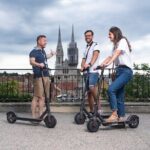
- Private, English-speaking guide: you’re not sharing a cramped headset tour with strangers.
- Free-to-view stops: many locations are quick street-level history lessons rather than paid museum time.
- WW2 emphasis on Istedgade: you’ll learn why this street mattered for Danish resistance.
- Meatpacking District history stops: you get the industrial backstory behind today’s food-and-nightlife reputation.
- Christiania finish, guide can’t enter: you’ll reach the edge and then explore on your own.
Price and what $147.96 buys you in Copenhagen time
At $147.96 per person, you’re paying for one thing more than anything: time with a local guide in a private format, plus a set route that connects two very different neighborhoods. It’s also a route where most stops are free to view, so your “spend” mostly goes to guided context, not admissions.
This isn’t a tour designed to fill your day with indoor attractions. It’s built for walking and noticing—old moats turned into a street, housing blocks with protest stories, and industry buildings that explain how Copenhagen worked before “cool” became a brand.
If you choose the Full Option, the day gets better value because you add a traditional tasting + drink and a 45-minute classic Danish restaurant lunch. If you don’t, you can still have a great tour, but plan your meals with Copenhagen’s restaurant timing in mind.
You can also read our reviews of more private tours in Copenhagen
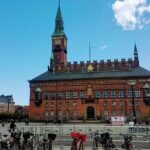
Starting at Viktoriagade: the “moat street” that tells you Copenhagen’s trick
Your tour kicks off at Viktoriagade 8. The first stop sets the tone: you’re standing near a place that used to be part of Copenhagen’s fortifications built by Christian IV in 1600, protected by a moat. Then the practical city decision arrived: in 1950, the area redeveloped, the moat ended up looking like an open sewer, and the famous street was placed over it.
That’s a very Copenhagen lesson. The city doesn’t just preserve history behind glass; it repurposes it. Along the street, buildings went up in lots starting in 1856, including charity buildings for groups like officers’ widows. The mid-1800s buildings at numbers 8, 10, and 12 are listed in Denmark’s protected buildings register, which is your clue that these streets keep official historical status, not just local charm.
Tip for your walk: look up. Many of these stories are tied to specific addresses, so being able to glance at façades helps the explanations stick.
Det Ny Teater and the “passage” idea that shaped Vesterbro
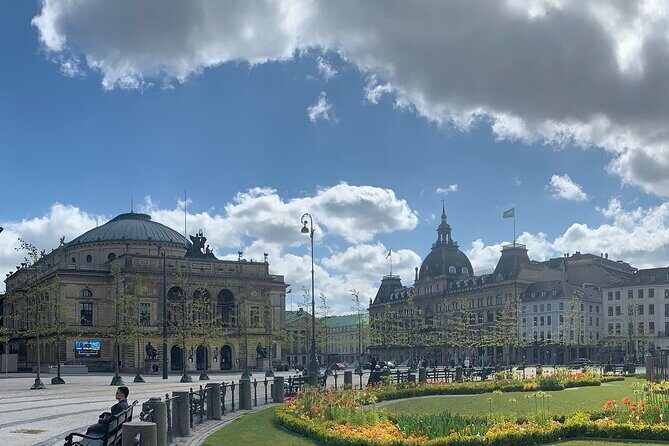
Next comes Det Ny Teater, opened in September 1908. It’s one of Denmark’s largest theaters, but the interesting part is the urban planning behind it: the construction aimed to create a big theater while also opening a passage between what used to be Gammel Kongevej and Vesterbro Passage (now folded into Vesterbrogade).
So instead of thinking of the theater as an isolated landmark, you can see it as a connector. Copenhagen’s major buildings often act like infrastructure, shaping how people move and where neighborhoods grow.
This stop is quick, with free admission, so use it like a mental marker: you’re moving from fortifications to transportation-style urban thinking.
Værnedamsvej: from a beer collector to Slagtergaden
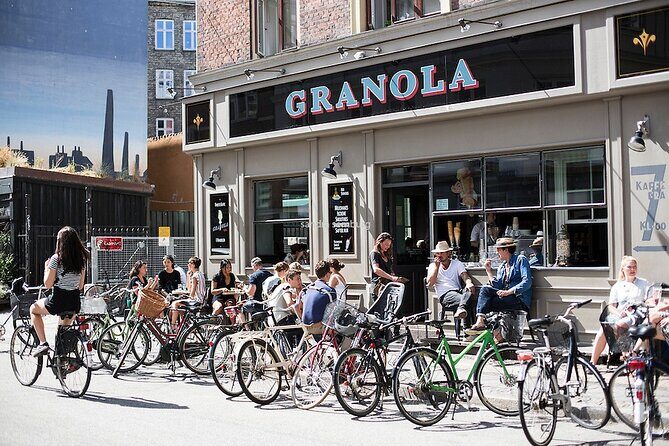
At Værnedamsvej, the street name ties to Werner Dam, a beer collector who bought land in the 1700s and opened a popular beer garden there. It also carried a rougher nickname: Slagtergaden, meaning Butchers’ Street, because butchers dominated the area.
I like this stop because it shows how Copenhagen mixed pleasure and work. You don’t get a clean “this was only for fun” story. You get a neighborhood that hosted both. And even if you never eat in that exact spot, you understand why Vesterbro had an active street life long before today’s restaurant scene.
Saxogade: housing protest and overcrowding that focused on children
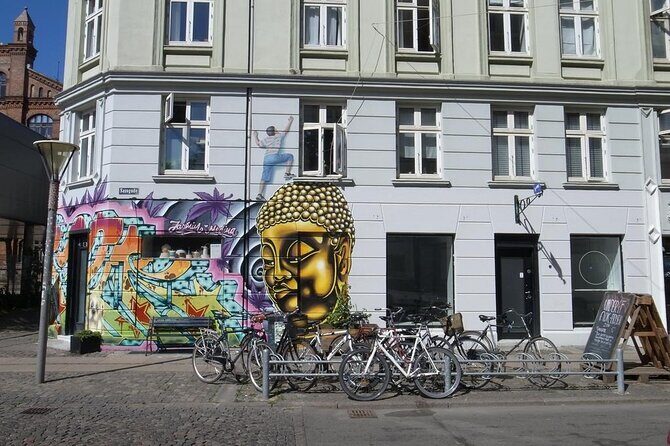
Then it’s Saxogade, where residents sent a large protest letter in the early 1950s. The complaint wasn’t about aesthetics—it was about miserable housing conditions. This neighborhood originally leaned toward factory workers arriving from the countryside, hoping for a better life.
The heart of the issue was families living packed into tiny one-room apartments, sleeping up to ten people. That context matters when you walk the streets now. You’re not only looking at buildings; you’re seeing the physical scale of people’s everyday limits—and the push that came from that.

Skydemuren and Istedgade: bullet-trap wall, then resistance street
At Skydemuren, you see the castle-like wall tied to a shooting range: it was built as a bullet trap to protect traffic along the then-new Istedgade from projectiles connected to the Royal Danish Army at Skydebane (where Skydebanehaven is today). The wall also creates a point de vue for Skydebanegade, where the opposite side of Istedgade starts with uniformly decorated houses.
It’s a reminder that “nice city view” sometimes comes from very un-romantic engineering.
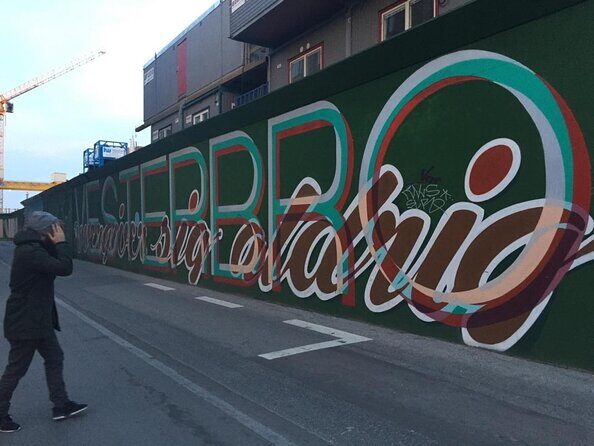
And then you hit Istedgade, one of Vesterbro’s most important streets. The name remembers the 1850 Battle of Isted in the First Schleswig War. It’s also known for its role during World War II and for later reputations connected to drug activity and a large red light district in Scandinavia.
But the tour’s standout takeaway here is the wartime line: during WWII, Istedgade was a refuge for the Danish resistance, and the slogan goes that they can take Rome and Paris, but Istedgade would never fall.
Istedgade 31: Stjerne Radio and the BBC broadcast through loudspeakers
Just around the corner is Istedgade 31. Here, Stjerne Radio opened in September 1942, run by Carl Munck and JK Søndergård. The key detail: they began broadcasting English programs of the BBC radio through loudspeakers.
This is one of those stops where you feel why street-level history matters. It’s not a distant date on a timeline. It’s a neighborhood infrastructure—radio signals and listening—turned into part of survival.
Meatpacking District stops: from industry horsepower to modern Copenhagen
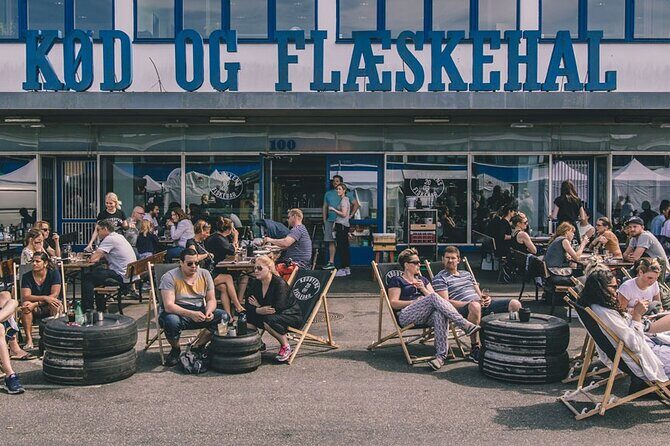
After the darker wartime pieces, the tour shifts to the Meatpacking District. You’ll be told it’s a revitalized industrial area known for trendy dining and nightlife today. The point isn’t to judge the present. It’s to understand how the present happened.
Next is Oksnehallen, an exhibition space inside an old market. Built in 1891 to hold merchant offices and a capacity for 1,600 heads of cattle, it stayed in use until the White Zone opened in the 1950s.
This is your bridge between eras: you see the scale of industrial life, then stand in the same volume while it’s used for exhibits. Even if you don’t go inside for long, the building’s purpose gives you a better lens for what you’re seeing.
Then comes Halmtorvet, Copenhagen’s haymarket history. It used to sit inside the western city gate area (where City Hall Square is now). It closed on January 1, 1888, then moved outside the new livestock market opened in 1879. Market days were Wednesday and Saturday, with up to several hundred loads of hay and straw traded for distribution to cattle and horse stables.
It’s not glamorous history. That’s exactly why it’s useful. You understand how a city fed animals, moved goods, and organized workdays—before the sidewalks became nightlife zones.
Support institutions on Istedgade: a different kind of neighborhood history
Two quick stops keep the tour grounded in social reality, not just old walls and architecture.
First is the Men’s Home for homeless, established in 1910. It’s a private organization subsidized by the Danish state, aiming to help homeless and vulnerable people recognize and use their own resources to build a good life and contribute to a diverse society.
Then comes Maria Church at Istedgade 20. Opened in 1909, it serves as a shelter for homeless people, families in need, and socially marginalized groups. It provides daily care to vulnerable groups listed here include illegal immigrants, drug addicts, prostitutes, and people whose lives are criminalized.
These are short stops, but they change how you read everything else. Copenhagen isn’t only old. It’s also active, caring, and—often—quietly functional.
Copenhagen H and Knippelsbro: the city’s movement system
You’ll then reach København H, Copenhagen’s main station. The building opened in 1911, inspired by the style of the town hall building. It’s the largest railway station in Denmark (with Nørreport higher daily passenger flow, but København H still takes the top spot overall). It has 7 platforms and 13 tracks.
Why include a station on a neighborhood tour? Because stations are how cities stitch districts together. If you get the station’s scale in your head, you understand why trains, bridges, and transit corridors matter so much in daily Copenhagen.
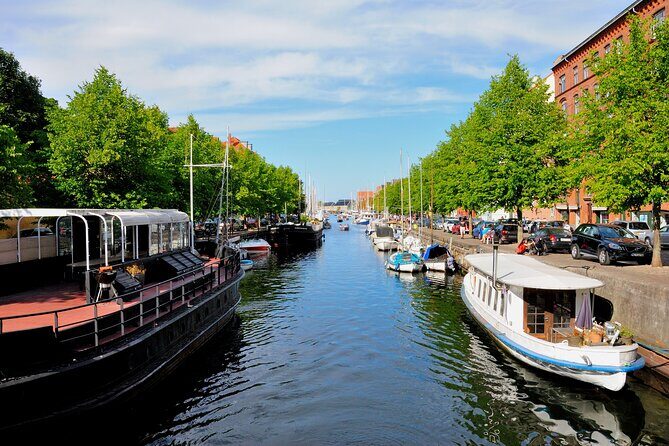
Just after that, you cross Knippelsbro, a 115-meter drawbridge built in 1937 that connects Copenhagen to Christianshavn. The name comes from Hans Knip, who operated the bridge and collected tolls from passing ships in 1641, living with his family right on the bridge.
Even if you’re not a bridge nerd, this stop gives you a practical feel for why Christianshavn remained distinct while still connected.
Christians Kirke: rococo style and the German congregation chapter
In Christianshavn, you visit Christians Kirke, a rococo-style church built 1754 to 1759. It originally served as the Frederik’s German Church, named after Frederick V, and for many years it was for the German-speaking congregation that wanted their own church.
This is a good stop when you want Copenhagen’s multicultural layers without going too far afield. It also helps you remember that “Copenhagen history” isn’t only Danish-only stories.
Strandgade 4 and Asiatisk Plads: industry and global trade behind the calm streets
At Strandgade 4, you’ll hear about a building from the 1780s that previously housed the DieselHouse Museum (now moved to København SV). The focus is on B&W, tracing back to a one-man smithing workshop starting in 1843. B&W became one of Denmark’s largest workplaces, holding that title for a long stretch earlier than the usual industrial arc. The data here links the symbol of Danish industry across the dates 1865 to 1979, and today that name shows up through MAN Energy Solutions.
Then you move to Asiatisk Plads, which used to be the Danish Asia Company base (1732–1843). Today, it’s home to the Ministry of Foreign Affairs and a convention center.
So you get two lenses in a short walk: how Copenhagen manufactured power and how it managed far-reaching trade.
Sankt Annae Kirke area, Wildersgade, and Wilders Plads: old streets you can still feel
Next is Sankt Annae Kirke, where you can see listed buildings from the 1600s to 1700s. A highlight is the row of houses 8–22 with remnants from some of the oldest houses in Copenhagen, built around 1650. House number 14 is noted as the best preserved.
Then you’ll stroll by Wildersgade, dating 1617–1622 from the founding of Christianshavn. It’s quiet today, with cobblestones, mansions, and old warehouses from the 1700s to 1800s.
After that, the tour points you toward Wilders Plads. It began as a busy market square but is now a place to relax with water views. You’ll also find one of the most expensive marinas in Copenhagen (access restricted to yacht club members). The tour also highlights Wilders Plads 10, a beautiful two-story timber-framed house built in 1736, originally a sailmaker’s workshop and living space.
These stops matter because they’re small enough to ignore on your own—and powerful enough to make you feel the age of the streets without needing a ticket.
Our Saviour and the “choose-your-own” ending at Christiania
The final religious highlight is Church of Our Saviour, a baroque church famous for its twisted spire and an external spiral staircase you can climb to reach the top. It’s still a living parish church for about 8,000 people, so it’s not only a photo stop.
Finally, you reach Freetown Christiania. Here’s the core story: it’s a partially self-governed neighborhood with around 1,000 residents, created in 1971 by hippies protesting the lack of housing. They used military land that the Danish army had abandoned. The community covers about 34 hectares, and it’s described as the second most visited sight in Copenhagen after Tivoli, with about half a million tourists per year.
Two practical notes from the tour format:
- The guide will not go with you into Christiania (they aren’t allowed).
- This means your ending becomes your own pacing. You can wander, observe, and decide what feels appropriate on the day.
This is where the tour’s “alternative” promise really clicks. You’re not just learning Copenhagen—you’re stepping into a place that still challenges the normal script.
Guides make the difference: the Alessandro/Grazi/Karolina effect
The strongest feedback on this experience isn’t about any single building. It’s about the guide style.
For example, Alessandro is praised for taking people to places they wouldn’t discover on their own, plus making time for a tasting stop. Grazi gets credit for being excited to share, and for connecting personal stories to Copenhagen. Karolina is noted for taking time and making the walk engaging, with lots of street-level context.
So what should you do? Ask questions early. If you care about housing, wartime life, or how industries shaped today’s neighborhoods, say so at the start. A private guide can steer you without turning it into a random detour festival.
Timing and walking reality for a 3.5 to 4 hour private route
This is a 3 hours 30 minutes to 4 hours walk, and the stops are mostly quick. That means the experience depends on your pace. If you linger too long at one intersection, you’ll cut short another.
Also, some parts of the route include transit support—metro tickets are included—so you’re not stuck figuring it out if you need to jump rather than walk the last bit.
If you want maximum value, wear comfortable shoes and treat each stop like a story prompt: you’re collecting details that give the streets meaning.
Should you book this Vesterbro and Christianshavn alternative private tour?
Book it if you want a Copenhagen day that’s about real neighborhoods, not only museum headlines. It’s a great match for history lovers who like their facts attached to places you can point at, and for people who enjoy mixing social history (housing, support institutions) with wartime details and city planning.
Skip it or manage expectations if you’re hoping for a long food-focused experience. The tasting and drink (and lunch) are part of the Full Option, and otherwise it’s more of a street-story tour than a meal crawl. Also, plan your Christiania time since the guide can’t enter with you.
If you like your guide personal and responsive—names like Alessandro, Grazi, and Karolina show up in the guide mix—this is one of the more straightforward ways to see Copenhagen’s “other side” with less hassle.
FAQ
How long is the Copenhagen Alternative Private Tour: Vesterbro & Christianshavn?
The tour runs about 3 hours 30 minutes to 4 hours.
Is this tour private?
Yes. It’s a private tour/activity, so only your group participates.
Where does the tour start and where does it end?
It starts at Viktoriagade 8, 1620 København and ends at Freetown Christiania.
Is the tour offered in English?
Yes, it’s offered in English.
Are metro tickets included?
Yes. Metro Tickets are included.
Is lunch included?
Lunch is only included in the Full Option, and it’s listed as 45 minutes in a classic Danish restaurant.
Is there a tasting or drink included?
A local tasting and a drink in a traditional restaurant are included only in the Full Option.
Does the guide go into Freetown Christiania with you?
No. The guide will not go with you into Christiania because they are not allowed.
What happens if it rains?
The tour will not be cancelled in case of rain.
Can I cancel for free?
Yes, free cancellation is available. You can cancel up to 24 hours in advance for a full refund.