REVIEW · AARHUS
Aarhus: Surprise City Walking Tour with Local Guide
Book on GetYourGuide →Operated by LocalBini AG (EU) · Bookable on GetYourGuide
Aarhus has an old-soul shortcut to it. This tour shines in Latinerkvarteret with its oldest-lane charm, and then flips your expectations at the Skovgaardsgade bus station art stop.
I like how the route mixes postcard stops with real neighborhood texture, not just a checklist. One watch-out: guide quality can swing the depth of the stories, so go in ready to ask questions.
If you’re hoping for a heavy history lecture, you might feel it’s more of a guided walk than a deep lesson plan. That said, when the guide is on form, the cultural context can be surprisingly sharp, like the Mikel-led approach that connects Danish culture to the political system, or the fun, friendly energy people associate with Kate. Bring comfortable shoes and expect a lot of street time.
In This Review
- Key highlights I’d build your day around
- Aarhus in 90 minutes: the walk-through-you-actually-remember it
- Latinerkvarteret: Aarhus oldest part and why it works as a starting point
- Skovgaardsgade bus station: the art stop that turns practical into interesting
- Møllestien cobblestones to Aarhus Cathedral: a classic route with one big focal point
- Dokk1 public library: modern culture, books, and local everyday energy
- Price and value: what $128 buys in 90 minutes
- The guide experience: when it’s excellent, and when it’s just okay
- What to bring and how to plan your 90-minute window
- Who should book this Aarhus walk, and who should skip it
- Should you book this Aarhus Surprise City Walking Tour?
- FAQ
- How long is the Aarhus walking tour?
- What is included in the tour price?
- Is the tour private or in a group?
- What languages are the guides available in?
- Are food and drinks included?
- What should I bring?
- Is the tour suitable for people with mobility impairments?
- What is the cancellation policy?
Key highlights I’d build your day around
- Latinerkvarteret first: Aarhus oldest streets set the tone fast.
- Skovgaardsgade bus station art: a seriously unexpected gallery stop.
- Møllestien cobblestones: the kind of street you slow down on.
- Aarhus Cathedral views: Denmark tallest church as a focal point.
- Dokk1 public library: books and culture in a modern civic space.
Aarhus in 90 minutes: the walk-through-you-actually-remember it

This is a short, focused walking tour—about 90 minutes—designed to give you a working mental map of Aarhus. The format is simple: you follow a local guide around central sights, with enough stops to feel like you did something, without dragging your feet all day.
What I like most is how the itinerary avoids the most obvious loop. You start where the city’s age shows—Latinerkvarteret—then you hit an art moment most visitors would never seek out, at the Skovgaardsgade bus station. After that, you get a classic old-street feel on cobblestones, a big vertical landmark with the cathedral, and then you end in a place that feels like the city at day-to-day volume: Dokk1.
The tour is not a museum marathon. It’s street level. That’s great for orientation and quick learning. The only drawback is that if you get a guide who stays general, you may wish for more specifics or deeper answers.
You can also read our reviews of more walking tours in Aarhus


Latinerkvarteret: Aarhus oldest part and why it works as a starting point

Starting in Latinerkvarteret makes sense. This isn’t a random neighborhood. It’s the city’s oldest part, and that age shows in the street feel: charm that’s less about staged beauty and more about the way old lanes squeeze together.
As you walk, you’ll notice the difference immediately. Narrow alleys, older-looking architecture, and cobblestone surfaces create a kind of natural slow-down. A good guide uses that physical environment to tell stories that click. In practice, it’s the best part of the tour for people who like architecture-as-evidence: you don’t just hear that the city is old; you feel it under your shoes.
Why this stop is valuable for you: it calibrates your eyes. After Latinerkvarteret, the rest of Aarhus starts to make more sense—where the city has changed, where it keeps a sense of continuity, and how modern culture fits next to old streets.
A consideration: because this is mostly exterior walking, winter or rain can make the pace feel tighter. If it’s wet, your best friend is footwear with grip.
Skovgaardsgade bus station: the art stop that turns practical into interesting

Then the tour does something clever: it takes you to the Skovgaardsgade Bus Station to look at eclectic artwork. A bus station is not where you’d normally expect a highlight on a walking tour. That’s exactly why it’s smart.
Here’s what makes it work for your time: it reframes everyday spaces. You stop not just to look, but to understand why public art matters in a place where people actually wait, commute, and pass through. It’s also a great reset. After older lanes and quiet streets, this stop feels more contemporary and local-life centered.
The tour doesn’t sell this as a blockbuster gallery. It treats it like what it is: art you can access without buying tickets or hunting down opening hours. That makes it ideal if your schedule is tight, or if you like your culture stops low-pressure.
If you’re the type who likes asking questions, this is a good place to do it. You’ll get more out of the stop by prompting your guide to explain what you’re seeing and why it belongs there.
Møllestien cobblestones to Aarhus Cathedral: a classic route with one big focal point

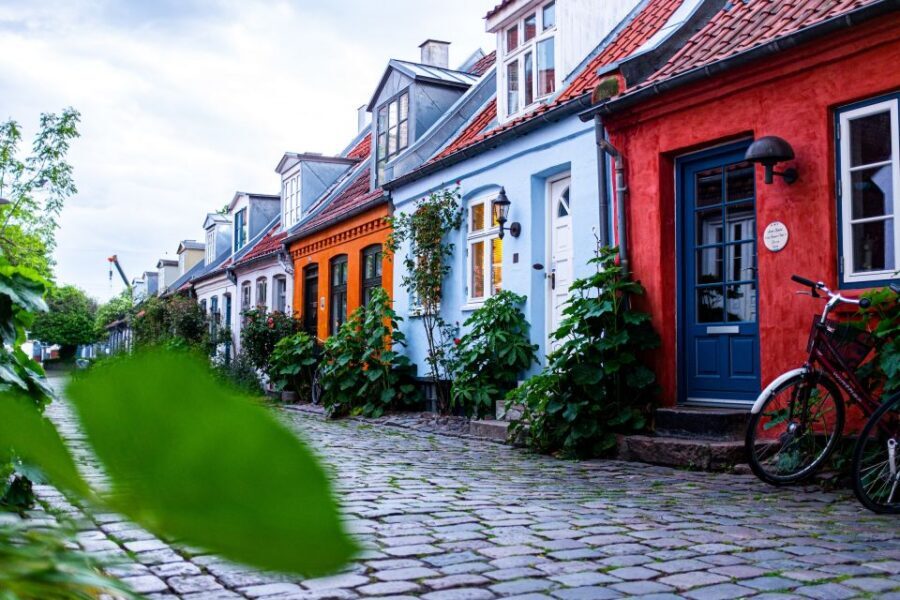
Next comes one of those streets that earns its reputation just by existing: Møllestien, with its cobblestone feel. This section is where the tour leans into atmosphere—slow footsteps, old paving, and the sensation of walking through a real part of town instead of a themed set.
From there, you look upward toward Aarhus Cathedral, noted on this tour as the tallest church in Denmark. The cathedral is the kind of landmark that reshapes your walk. Even if you’re not a church-history fanatic, a tall structure gives you a visual anchor and a satisfying sense of arrival.
Why this segment matters: it balances texture and scale. Møllestien gives you details at foot level. The cathedral gives you scale you can’t miss. Together, they make your memory of this tour stick.
A potential drawback: if you’re visiting Aarhus during a high-traffic time, this section can feel more like navigation than sightseeing, simply because there’s a lot around a major landmark. Your best strategy is to let your guide set the pace, then pause intentionally for photos and for a moment of just looking up.
Dokk1 public library: modern culture, books, and local everyday energy
The final stop is Dokk1, the public library. For a walking tour, that’s an excellent ending point, because it’s both practical and symbolic. You’re stepping into a civic space that signals how the city thinks about learning, community, and culture.
This isn’t a quiet lecture hall experience. It’s a place where books and public life intersect. Even if you don’t go inside for a long browse, the point is to experience what a modern Danish city treats as normal: public institutions that welcome people.
For you, the value is timing. Libraries work well as an ending because they help you decompress after a walking-heavy route. You can slow down, reset your sense of direction, and decide what you want to explore next on your own.
If your guide is strong, they’ll connect this stop to how Aarhus functions today, not just how it looked centuries ago. That’s the difference between a tour that’s a string of sights and one that gives you a city lens.
You can also read our reviews of more guided tours in Aarhus


Price and value: what $128 buys in 90 minutes
At $128 per person for a 90-minute guided walk, this isn’t the cheapest way to see central Aarhus. But it can still be good value, depending on what you want from a guide.
Here’s the fair way to think about it:
- You’re paying for a local’s eye and for the time-savings of having someone choose the route.
- You’re not paying for ticketed attractions or an all-day program.
- Small group or private options mean the guide should be able to tailor explanations—when the guide is able to go deeper.
The reviews provide a useful reality check. Some people loved the guide’s city knowledge and cultural context. One person flagged Mikel as especially strong, with lots of information even touching Danish culture and the political system. Another praised an amenable guide who matched what they wanted to see. On the other hand, at least one private-tour experience felt light on answers—more like a stroll around town than a guided history thread—and a rain-soaked day raised the question of whether the content was distinctive enough.
So my practical advice: if you book, come with two to three questions you genuinely care about. Ask about what you’re seeing in Latinerkvarteret, why the bus station art matters, and what the library represents in daily Aarhus life. A good guide will use those prompts to turn the stops into stories. A weaker one will still offer the basic route—but you’ll get less out of it.
The guide experience: when it’s excellent, and when it’s just okay
This tour lives or dies on guide performance. And based on the spread of feedback, that’s not just your imagination.
When it’s excellent, you get:
- clear, confident explanations at each stop
- context that links architecture, public art, and modern civic space
- a guide who can answer simple questions without dodging
When it’s merely okay, you may find:
- less history detail than you hoped
- fewer chances to steer the conversation
- explanations that feel similar to what you’d read in a standard city guide
One thing I’d suggest you do on the day: treat it like a dialogue. English and Danish are available, and you can use that flexibility. If your guide offers language options, pick the one that lets you ask faster and more directly.
And if it’s raining hard, remember that some people wished for a more sheltered or indoor plan. Since the tour is a walking route, weather can change the vibe even if the guide is great.
What to bring and how to plan your 90-minute window
This is a walking tour, so pack like it. You’ll want:
- a charged smartphone (useful for maps, photos, and quick lookups)
- comfortable shoes with grip for cobblestones
Also plan for the fact that a chunk of it runs outdoors. If the forecast is ugly, bring a compact umbrella or rain layer. You can still enjoy it, but your pace will be different.
Timing-wise, the length is perfect for fitting into a travel schedule. It’s long enough to feel like you got oriented, but short enough that you can turn right around afterward and explore at your own rhythm. If you’re hopping between neighborhoods during the day, this is a good first orientation walk.
Who should book this Aarhus walk, and who should skip it
I think this tour fits best if you:
- want a guided overview of central Aarhus without spending half a day
- enjoy street-level architecture and public spaces
- like when art is placed where people actually live their lives, not only inside ticketed buildings
I’d be cautious if:
- you need a step-by-step historical lecture style
- you get frustrated when guides cannot answer basic follow-up questions
- you have mobility constraints, since it’s not suitable for people with mobility impairments and involves walking on cobblestones
If you’re traveling as a couple or small group and you can ask direct questions, you’re more likely to get the kind of explanation that makes the stops feel connected.
Should you book this Aarhus Surprise City Walking Tour?
Book it if you want a smart route through the oldest streets, an art surprise at a real-world transit spot, cobblestone charm, a major landmark, and a modern library ending. The structure is strong for getting your bearings fast.
Don’t book expecting a museum-style deep dive. This is about walking, seeing, and having a local guide make the connections. At $128 for 90 minutes, it’s worth it when you match the tour to your style: curious, interactive, and happy to let the city guide your attention.
If you want to maximize your odds of a great experience, go in with questions and a flexible mindset about guide depth. If you do that, you’ll likely leave with more than photos—you’ll leave with a better sense of how Aarhus ties old streets and modern life together.
FAQ
How long is the Aarhus walking tour?
It lasts 90 minutes.
What is included in the tour price?
The experience includes a walking tour and a guide.
Is the tour private or in a group?
It offers private or small groups.
What languages are the guides available in?
The live guide is available in English and Danish.
Are food and drinks included?
No. Food, drinks, or snacks are not included.
What should I bring?
Bring a charged smartphone and wear comfortable shoes.
Is the tour suitable for people with mobility impairments?
No, it is not suitable for people with mobility impairments.
What is the cancellation policy?
You can cancel up to 24 hours in advance for a full refund.