REVIEW · COPENHAGEN
Grand Tour of Copenhagen – The Little Mermaid to Royal Castle
Book on Viator →Operated by Enjoy The Tours ApS · Bookable on Viator
2.5 hours can cover a lot of Copenhagen. This guided loop strings together major icons like the Little Mermaid, Rosenborg, Amalienborg, Christiansborg, and Nyhavn, with just enough context to make the city feel like more than postcards. Two big wins for me are the calm pace (no frantic sprint between stops) and the way the guide connects each place to real stories, from Danish resistance to royal power.
One thing to keep in mind: this is a highlights tour, not a museum marathon. You’ll get brief stops and photo moments more than long, slow time inside every building—so if you love deep gallery time, plan to come back later.
In This Review
- Key things that make this Copenhagen tour click
- Starting at Banegårdspladsen: timing, transport, and how you’ll move
- Tivoli Gardens (1843): a classic Copenhagen mood-setter
- Art and science in the middle: museums that add real variety
- The art stop
- The Natural History Museum plant collection
- Rosenborg Castle: Dutch Renaissance style that stays stubbornly consistent
- The Little Mermaid: the tide, the bronze, and the unexpected history
- Underground resistance: the Danish Resistance Museum break
- Gefion Fountain and Amalienborg: mythology up front, real power next
- Gefion Fountain
- Changing of the Guard at Amalienborg
- Frederiks Church (Marble Church): a dome you can’t miss
- Christiansborg: parliament ruins above, power below
- Opera photos and a canal-side moment: Thorvaldsen and Det Kongelige Teater
- Børsen’s dragon spire and the Christianshavn canal view
- Børsen (old stock exchange)
- Christianshavn and canal atmosphere
- Holmens Church and Kongens Nytorv: navy ties and a royal square that feels designed
- Holmens Church
- Kongens Nytorv
- The Black Diamond library and Langebro’s moving span
- The Black Diamond
- Langebro bridge
- Nyhavn at the end: postcards with a backstory
- Price and value: what $61.40 buys you in real time
- Who should book this Copenhagen highlight loop
- Should you book: my practical recommendation
- FAQ
- What’s the total duration for the tour?
- How much does the tour cost?
- Is pickup available?
- What’s included in the price?
- Is lunch included?
- How big is the group?
Key things that make this Copenhagen tour click
- A tight highlights route that strings together Little Mermaid, Rosenborg, Amalienborg, Christiansborg, and Nyhavn
- The Little Mermaid details you don’t see on a postcard (tide-access rock, bronze sculpture history, and protest graffiti)
- Amalienborg guard change at midday with the Life Guards on a daily schedule
- Royal + resistance stops in one sweep including the underground Danish Resistance Museum
- Big-sight photos without the logistics headache thanks to pickup, an air-conditioned vehicle, WiFi on board, and an audio guide
- Small group limit of 33, so you’re not buried in a sea of people
Starting at Banegårdspladsen: timing, transport, and how you’ll move
The tour begins at Banegårdspladsen 2 at 9:30 am, and it ends back at the same meeting point. Duration is listed around 2 hours 30 minutes, and it can stretch to up to 3 hours, which matters if you’re timing a cruise day.
You travel by air-conditioned vehicle, and WiFi is provided onboard. There’s also an audio guide running alongside the host/driver, so you’re not stuck trying to read a lot while on the move. Pickup is offered, and the whole setup is built for short-term visitors who need structure without spending time figuring out transit.
You can also read our reviews of more tours and experiences in Copenhagen.


Tivoli Gardens (1843): a classic Copenhagen mood-setter
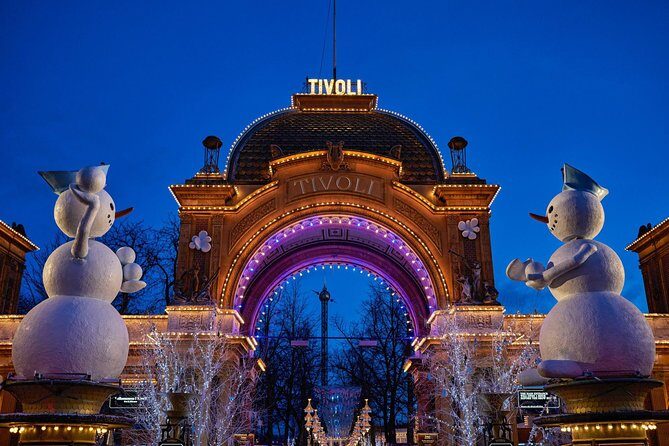
Your first stop is Tivoli Gardens, opened in 1843 by Georg Carstensen. Even if you don’t go inside, it’s a useful start because it immediately tells you Copenhagen is not just royal monuments. It’s also leisure, design, and public life.
I like using Tivoli as a kickoff because the visuals work instantly: gardens, paths, and the sense of an older city tradition. You’ll have only a short window here, so don’t treat it like an all-day theme park visit—treat it like a breather before the heavier royal sites.
Art and science in the middle: museums that add real variety
After Tivoli, the route swings into a blend of culture and science that keeps the tour from turning into a straight line of palaces.
The art stop
You’ll see an art museum with antique sculptures from the Mediterranean area, plus French and Danish works from the 19th century. This is a great reset if you’ve already been outside in the cold wind or crowds. It also gives you a sense of Danish tastes beyond royal architecture.
The Natural History Museum plant collection
Next comes a more unusual highlight: the State Natural History Museum’s plant collection, described as Denmark’s largest, spread over 10 hectares. You’ll pass major features tied to scientific curiosity, including the Palm House and a sculpture called Athena and Marsyas by Myron. You also have ties to astronomy with the Astronomical Observatory / Østervold Observatory and Tycho Brahe (1546–1601).
Even if your eyes glaze over at astronomy names, you’ll still appreciate the shift. Copenhagen can feel formal and ceremonial—this portion reminds you the city also grew through experiments, research, and big thinkers.
Practical tip: since the day is packed, wear shoes you can stand in comfortably even for short museum stops.



Rosenborg Castle: Dutch Renaissance style that stays stubbornly consistent
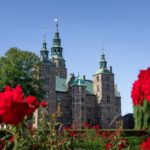
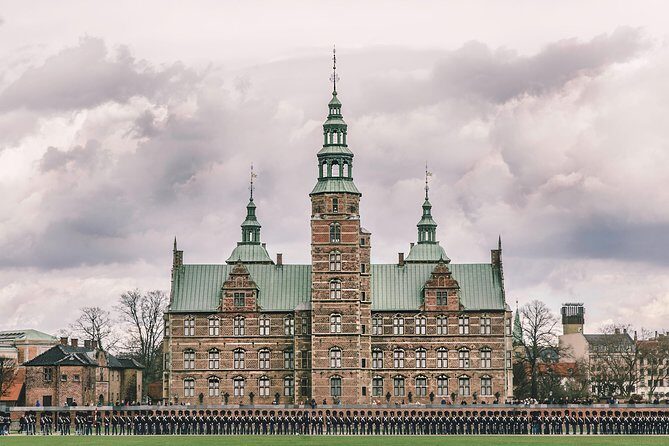
At Rosenborg Castle, you get a clear slice of royal building style. It was built in Dutch Renaissance style by King Christian IV, and the exterior is noted as being the same as the day it was built.
That consistency is what makes this stop satisfying. A lot of historic buildings get patched, rebuilt, or altered beyond recognition. Here, the point is that the look you see is closely tied to the original design. It’s a good place to slow down for a few minutes, shoot photos from multiple angles, and let the details register.
The Little Mermaid: the tide, the bronze, and the unexpected history
The Little Mermaid stop is the headliner for good reason, but the tour adds layers that most quick photo stops skip.
Here’s what you’ll learn:
- She has been sitting on her rock since 1913
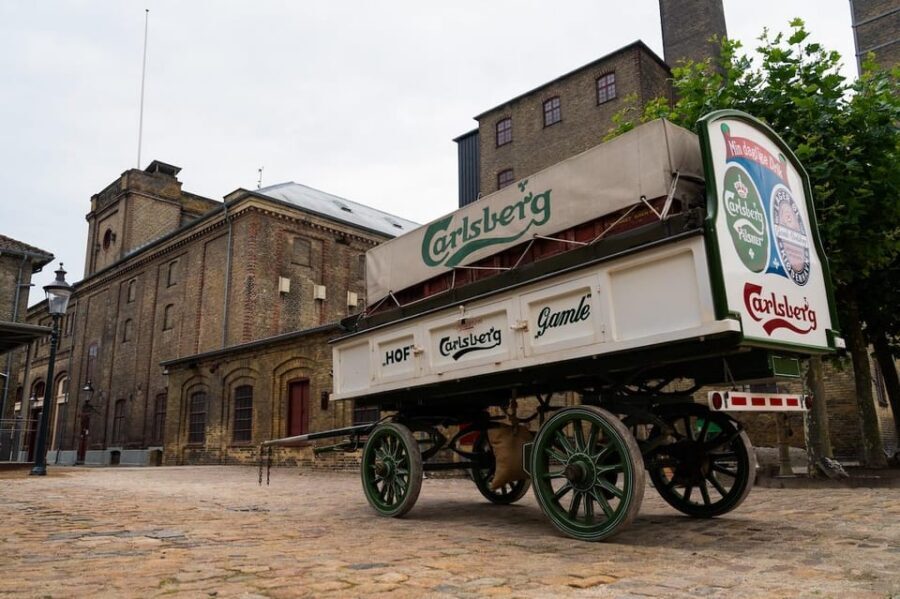
- The sculpture was a gift from Carl Jacobsen, connected to the Carlsberg Brewery
- It’s bronze on a granite rock
- The rock can be accessed at low tide
- The sculpture is inspired by Hans Christian Andersen’s mermaid story
- The statue has been attacked: it’s been beheaded twice, had an arm cut off, and has been splattered with red paint
- Recently, the words Free Hong Kong were painted on her
That’s a lot of story for a spot you might think is just a single pose at a harbor edge. What I like is that the tour frames the Mermaid as a cultural object—beloved, targeted, and used as a symbol by different moments in modern history.
How to enjoy the stop:
- Bring your camera, but also look for the “why” behind the image.
- If timing lines up with low tide, you’ll get a better sense of where she sits relative to the rock.
Underground resistance: the Danish Resistance Museum break
Next you’ll reach the Danish Resistance Museum, located underground in a newer building opened in 2020. The previous building burned in 2013, but many items were saved. The museum focuses on life under German occupation from 1940 to 1945, with attention on the work of Danish resistance groups.
This stop is not there for spectacle. It gives the city balance. You start with fairytale art and royal architecture, then you’re hit with the real stakes of survival and underground networks. It’s also a nice change of pace from outdoor walking—cooler and calmer, with a clear theme.
Gefion Fountain and Amalienborg: mythology up front, real power next
Gefion Fountain
The Gefion Fountain is tied to mythology. Gefion is the goddess who turned her sons into oxen and ploughed the island of Sjælland out of earth from Sweden. The fountain was paid for by the Carlsberg Foundation and designed by Anders Bundgaard, sculpted between 1897 and 1899. The basin was completed in 1908, and the fountain was first activated that same year.
Even if you’re not big on legends, this stop works because it’s visually strong and conceptually clear: you’re looking at a story about geography and origin.
Changing of the Guard at Amalienborg
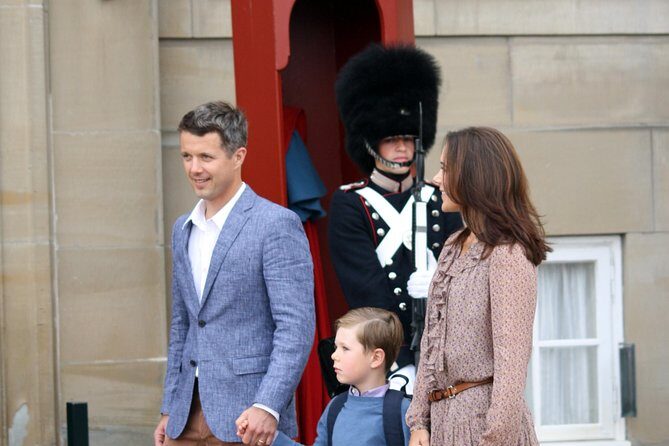
Then comes one of the most practical moments on the route: changing of the guard at Amalienborg Castle at midday. It’s free, and you get about 20 minutes.
Amalienborg’s palaces date to the 1760s, with the royal family moving in in 1794 after Christiansborg Castle burned. The square holds four palaces: Christian VII’s, Christian VIII’s, Frederik VIII’s, and Christian IX’s. The tour notes Frederik VIII’s Palace as the place where King Frederik X and Queen Mary stay in Copenhagen.
What I like here is the schedule. Knowing it happens daily at midday makes planning easier, especially when your time is tight.
Frederiks Church (Marble Church): a dome you can’t miss

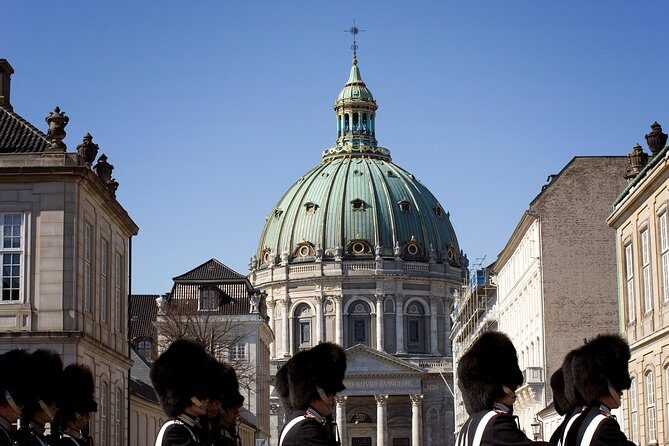
Next is Frederiks Church, also called the Marble Church. Commissioned by King Frederik V and designed by Nicolai Eigtved in 1740, the project slowed after Eigtved died in 1754, and construction paused in 1770. Later, in the late 1800s, Ferdinand Melhdahl took over. Because of budget limits, the remaining portion was built using limestone instead of marble.
It’s capped by a dome noted as the third largest church dome in Europe. Even without entering, you’ll see the monumentality clearly, and it helps you understand why Copenhagen’s skyline feels so “designed,” not random.
Christiansborg: parliament ruins above, power below
At Christiansborg, you’re in the heart of Danish government. The present building dates to 1928, and Folketing (the Danish parliament) meets there.
What makes Christiansborg extra interesting is the layering:
- Below the building are ruins of the first Copenhagen Castle, built in 1167 by Bishop Absalon
- The first Christiansborg Palace was built in 1740 by King Christian VI
- In 1992, Christiansborg’s church roof caught fire; repairs finished in 1997
- The site includes King Frederik X’s throne
- Denmark has no coronations, so the ceremony-style focus doesn’t match what many visitors expect
- The tour also notes where the king waved from the balcony during installation, referenced with Prime Minister Mette Frederiksen
This is one of the stops where the audio guide and host add value because you’re looking at a complex site with multiple eras stacked together.
Opera photos and a canal-side moment: Thorvaldsen and Det Kongelige Teater
You’ll also pass Det Kongelige Teater (Operaen), where there’s time to grab photos of the Copenhagen harbor and the Amalienborg palace area. It’s short—about 5 minutes—but the view is a good “put it all together” moment.
Nearby is a museum connected to Bertel Thorvaldsen’s grave by the canal. This one helps the route feel Danish in a softer way: art, sculpture, and public space rather than only official buildings.
Finally, there’s an equestrian statue of Bishop Absalon from 1902. It’s a small step but meaningful because Absalon is tied to Copenhagen’s early founding story.
Børsen’s dragon spire and the Christianshavn canal view
The route then pivots into the older trading and canal neighborhoods.
Børsen (old stock exchange)
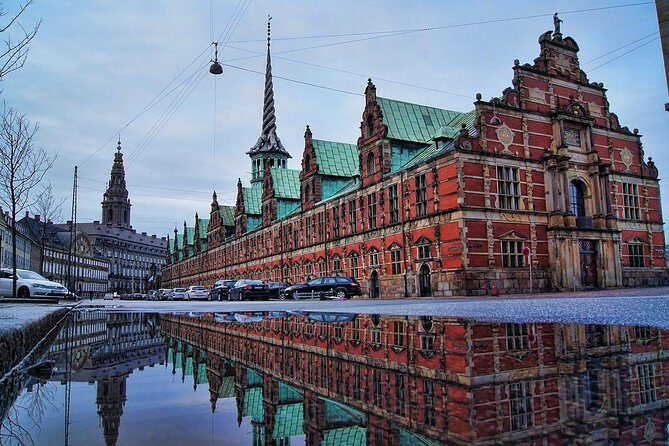
Børsen is the old stock exchange building dating to the 1620s, built by King Christian IV. It functioned as a stock exchange into the 1800s, and originally the upper floors were used for trading physical commodities.
Today the building is owned by Dansk Erhverv. The spire is made of intertwined dragons’ tails, which gives you a strong photo subject and a clear sense of Copenhagen’s mix of commerce and symbolism.
Christianshavn and canal atmosphere
At Christianshavn, you’ll get time overlooking the canal and Our Saviour’s Church. This area feels like a different Copenhagen personality—more waterways, more angles, more “walkable city” vibes even if you’re staying in a vehicle for part of the day.
You’ll also stop for a mansion from the 18th century with collections and exhibitions about Denmark’s history, its people, and culture. Then you’ll see the Danish National Gallery, with international collections, temporary exhibitions, and children’s activities.
Since the tour is short, expect this to be more of a guided highlight walk than a deep interior museum day. Still, it’s the right choice if you want to taste what you might want to return to later.
Holmens Church and Kongens Nytorv: navy ties and a royal square that feels designed
Holmens Church
Holmens Church was built in 1619 by King Christian IV in a former anchor forge. It serves as a parish church and is also dedicated to the Danish Royal Navy, which fits because it’s described as the only church in Denmark next to sea water. Inside, you’ll find models of ships hanging from the ceiling.
Even in a short stop, it helps you see Denmark’s relationship with the sea as something practical, not just scenic.
Kongens Nytorv
Kongens Nytorv was commissioned in 1670 by King Christian V, inspired by Place d’Vendôme in Paris, and designed as a center of Copenhagen. The statue in the middle is of Christian V, placed there in 1688—noted as the oldest royal statue in Copenhagen.
Around the square are the Royal Theatre and the Royal Academy of Arts, housed in the former Charlottenborg Palace. This makes the stop feel like a planning statement: rulers didn’t just build for power; they built for city structure.
The Black Diamond library and Langebro’s moving span
Copenhagen is known for mixing old and new, and these two stops show that clearly.
The Black Diamond
The Black Diamond is an extension of the Royal Danish Library, built in 1999 and designed by Schmidt, Hammer and Larsen. It’s made with black granite from Zimbabwe and linked by a bridge to the main library building from 1906, by Hans J. Holm. There’s a reading room, music room, and a cafe and bookshop.
This is one of the most satisfying “modern Copenhagen” stops because it doesn’t feel like a generic office block. It’s built as a public place.
Langebro bridge
Langebro is a bridge that opens so ships can pass through the harbor. It was built in 1954, designed by Kaj Gottlob, and is listed as 7 meters high and 35 meters long. It’s owned by the Copenhagen City Council.
The tour also includes a fact I enjoy: a first Langebro existed in 1690, made of wood by King Christian V. In 2019, repair work began because concrete damage was found from rainwater, with repair costs noted at 307 million Kroner (€40 million).
You end up seeing engineering as part of the city’s personality—not just a background detail.
Nyhavn at the end: postcards with a backstory
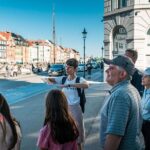
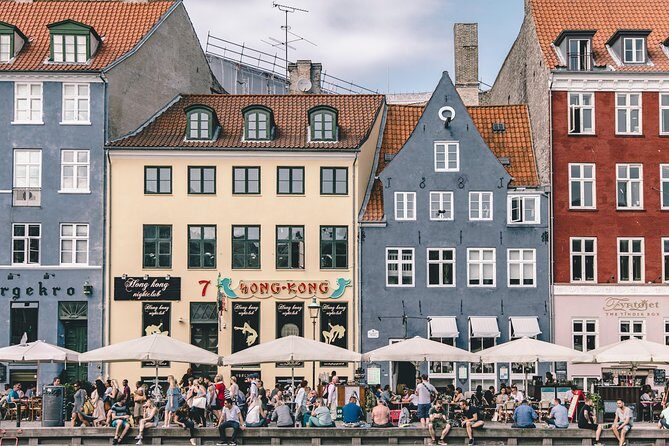
The route finishes with Nyhavn, built between 1671 and 1673 by Swedish prisoner of war. The oldest house there is Nyhavn 9, dated to 1681.
Nyhavn went through a rough period in the 1970s, then was renovated in the 1980s and is now lined with restaurants and pavement cafes. It’s also tied to Hans Christian Andersen, who lived there at different times in nos 18, 20, and 67.
And then there’s the memorial anchor at the end of Nyhavn, placed in 1951 for Danish merchant seamen who lost their lives during World War II.
This stop works best if you treat it like a final reel: you’ve just seen kings, science, art, and government. Nyhavn is where the city’s human stories show up in plain sight.
Note: lunch isn’t included, so if you need food, plan to pick something up around the area after the tour ends.
Price and value: what $61.40 buys you in real time
At $61.40 per person, this is a strong value for a short visit because you’re paying for:
- Guiding across many major sights
- Transportation by air-conditioned vehicle
- WiFi onboard
- An audio guide
- A small group size (max 33)
Also, several key moments on the schedule are listed as free admission, including the Little Mermaid stop and the Amalienborg guard change. That helps stretch your time without adding extra ticket lines.
The tradeoff is the one you should be honest with: you’re not buying deep museum time. You’re buying city orientation, with enough detail to decide what you want to revisit later. For cruise day planning, the logic is even simpler: you need movement and timing more than slow wandering, and this tour is built for that.
Who should book this Copenhagen highlight loop
This works especially well if you:
- Have only a few hours in Copenhagen and want the big names handled
- Are taking a cruise and need an efficient plan before/after the ship
- Want both royal sites and real-life stories like resistance history
- Prefer a guided route that keeps you from missing the obvious and the meaningful
If your style is slow, long museum hours, and deep reading, you may find some stops are too brief. But even then, it can be a great first day plan to get your bearings fast.
Should you book: my practical recommendation
If you want a clean, well-paced way to see Copenhagen’s headline attractions without spending your whole day on logistics, I’d book this. The standout part is the way the tour holds together: royal monuments, Danish cultural stories, and modern civic Copenhagen in one loop, with quick context so each stop makes sense.
The only reason I’d hesitate is if you know you’ll want long time inside museums and churches. This route is built for highlights, not extended stays. If that matches your needs, this is a smart, cost-friendly way to get a lot of Copenhagen—fast.
FAQ
What’s the total duration for the tour?
It runs about 2 hours 30 minutes and can take up to 3 hours.
How much does the tour cost?
The price is $61.40 per person.
Is pickup available?
Pickup is offered, and the meeting point is listed at Banegårdspladsen 2, 1570 København.
What’s included in the price?
Included items are an air-conditioned vehicle, WiFi on board, an audio guide, and a host/driver.
Is lunch included?
No. Lunch is not included.
How big is the group?
The tour has a maximum of 33 travelers.